What is a nexus letter?
A nexus letter is a signed medical opinion from a licensed clinician that links a current condition to your military service. It states how likely the link is in the VA’s own words: “at least as likely as not,” which means a 50 percent or better chance. It explains the medical reasoning from your records.
“Nexus” means link. To connect a condition to service, the VA looks for a current diagnosis, an event, injury, or illness in service, and a link between the two. The letter speaks to the link. When the evidence for and against is about even, the VA gives the benefit of the doubt to the veteran.
38 CFR § 3.303: direct service connection (opens in a new tab)38 CFR § 3.310: secondary service connection (opens in a new tab)38 CFR § 3.102: reasonable doubt (opens in a new tab)
Is a nexus letter the same as an independent medical opinion (IMO)?
Yes. A nexus letter is one kind of independent medical opinion: a medical opinion from a clinician outside the VA. The VA has to weigh it alongside its own exam.
The VA’s own exam is called a C&P (compensation and pension) exam. When the two disagree, the Board decides which is more convincing and says why. In the 617 Board denials we read from 2022 to 2026, the most common main reason was that the Board found the VA’s exam or opinion more convincing: 204 of them (33%).
What makes a nexus letter carry weight?
Clear medical reasoning tied to your records. In 451 Board grants that credited a veteran’s private opinion, the Board said 370 of those opinions explained their medical reasoning, 307 used the “at least as likely as not” standard, and 257 showed the clinician reviewed the records.
The Board also noted the clinician’s profession or specialty in 255 and the veteran’s own account in 247. When the Board turned a private opinion down, the reasons were mostly about how it was built. Of 104 denials where the Board weighed one, 96 pointed to a wrong or incomplete history, no sign of a records review, or no real reasoning.
How we counted: 1,721 Board rulings →
Do I need an exam to get a nexus letter?
No. A nexus letter is a medical opinion built from your records, so your clinician reviews your file remotely, wherever you live. There’s no exam, and you don’t have to travel. If you’re local and would rather meet in person, we can come to you.
What matters is what the records show. That is why we start by reading every page of them.
How does Anchorpoint work?
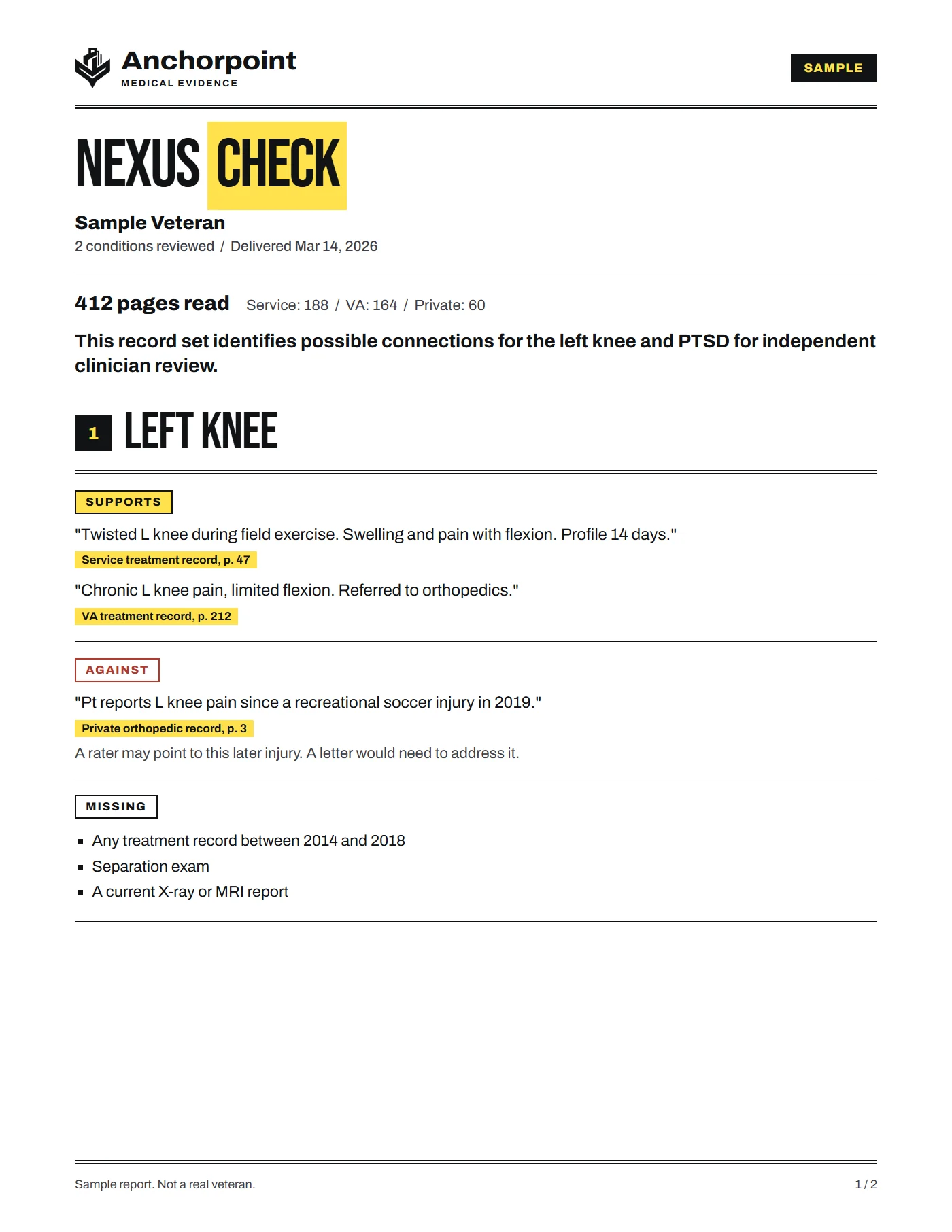
Three steps: records review, evidence call, nexus letter. First, our free Nexus Check reads every page of your service, VA, and private records and cites the page for each finding. Then we walk you through what we found on an evidence call. If you request a letter, we prepare a draft opinion, and a licensed clinician reviews it against your records, edits it, and signs only what they independently support.
The Nexus Check includes pages that work against the claim, so you see the whole picture before you decide anything. We don’t file claims or contact the VA for you.
Your evidence call can be by phone, by video, or in person if you’re in Skagit County or nearby (Whatcom, Snohomish, Island or San Juan). We can meet at your home, a library, or a VFW or Legion hall.
See a sample Nexus Check report →
My claim was denied. Can a nexus letter still help?
It can, if the denial was about a missing link between your condition and your service. Then a nexus letter is the kind of new and relevant evidence a Supplemental Claim needs. We read your decision letter’s reasons alongside your records first.
Your decision letter lists the reasons for the denial. Some reasons, like no current diagnosis, need other evidence first. Our denial decoder explains each reason in plain words.
Decode your denial letter →
Can I get a nexus letter for tinnitus, sleep apnea, a back or knee condition, or PTSD?
Yes. These are five of the conditions we see most. Each page shows why those claims got denied at the Board, what the winning private opinions had in common, and real decisions you can read on VA.gov.
Tinnitus: in 64 of 99 denials we read, the Board found the VA’s opinion more convincing.
Sleep apnea: in 25 of 103 denials, nothing in the file linked it to service.
Low back: in 46 of 126 denials, the Board found the VA’s opinion more convincing.
Knees: in 32 of 125 denials, there was no current knee diagnosis.
PTSD and depression: in 84 of 164 denials, there was no current diagnosis.
Tinnitus →Sleep apnea and PTSD →Back conditions →Knee conditions →PTSD and depression →
Why not just ask my own doctor for a letter?
You can, and a well-reasoned opinion from your own doctor can carry real weight. Many doctors decline to write nexus opinions, or write a line or two with no reasoning, which the Board often gives little weight. Our letters start from a page-cited review of your whole file.
I already know where the nexus is in my records. Do I still need the Nexus Check?
Tell us where it is. That helps. A licensed clinician won’t sign a letter without seeing the evidence in your records first, so we find it, confirm it and cite the page. Your lead gets us there faster, and the Nexus Check is free.
How much does a nexus letter cost?
Our fees are flat, never a percentage of your backpay, and the Nexus Check is free. Current letter prices are on our pricing page.
See prices →
What if the VA denies my claim anyway?
If the VA denies your claim, we write one rebuttal letter at no cost. It answers the medical-nexus reasons in the first VA denial of a claim that used your letter. It comes with every paid letter, unless the letter was refunded. The clinician signs only what they support, and we can’t promise what the VA decides.
Are you lawyers or VA representatives?
No. We don’t file anything or contact the VA for you. For filing and appeals, use an accredited representative; you can find one on VA.gov.