A nexus letter is a signed medical opinion that links a current condition to your service. For sleep apnea, the link often runs through a condition the VA already connects to your service, such as PTSD.
If the VA just denied your sleep apnea claim: your decision letter lists the reasons. We read those reasons next to your records, page by page.
If you haven’t filed yet: the points below are what the Board weighed in these appeals. A letter can cover them from the start.
Why sleep apnea claims get denied
We read 103 sleep apnea denials from the 1,721 Board rulings in our 2022 to 2026 study. The main reason the Board gave:
- 28% The Board found the VA’s own exam or opinion more convincing (29 of 103)
- 24% Nothing in the file linked sleep apnea to service (25 of 103)
- 20% No current diagnosis of sleep apnea (21 of 103)
- 15% No event, injury, or start of symptoms in service on record (15 of 103)
- 4% A private opinion gave no reasoning (4 of 103)
Even when it wasn’t the main reason, the Board often said the veteran’s own view of the cause wasn’t medical evidence (74 of the 103), noted no event in service (52) or a long gap after service (49), or found the link to another service-connected condition unsupported (32).
Counts come from what the Board wrote in each decision. None were Anchorpoint cases. How we counted
Where the VA exam and private letters fell short
These come from the decisions themselves.
- The VA exam blames weight, age, or the shape of your airway, and stops there. One VA opinion listed risk factors “clearly unrelated to service” without asking whether PTSD caused the weight gain.
- The VA exam asks only whether PTSD caused your sleep apnea. It skips whether PTSD made it worse.
- The VA exam skips the weight-gain link: a service-connected condition limits activity or changes eating, your weight climbs, and sleep apnea follows.
- Private letters fall short when they only say PTSD and sleep apnea tend to show up together, lean on undated or off-topic studies, or rest on a condition the VA hasn’t connected to your service.
What the Board looked for
“Probative” is the Board’s word for convincing. OSA means obstructive sleep apnea.
Sleep apnea linked to PTSD through weight gain.Granted · 2024
“The Board affords this medical opinion high probative value because the examiner cited to multiple pieces of evidence and medical literature to support the determination that the Veteran’s PTSD caused weight gain/obesity, which caused his obstructive sleep apnea.”
The VA exam skipped the weight gain. The private opinion walked through each step and backed it with studies.
Read decision A24040195 on VA.gov (opens in a new tab)Sleep apnea linked to diabetes.Granted · 2024
“The Board ascribes more weight to the March 2021 private opinion of record and finds the VA opinion to be of little probative value.”
The VA examiner said no studies link diabetes to sleep apnea, and gave little explanation. The private examiner reviewed the file and discussed the studies on that exact link.
Read decision A24040429 on VA.gov (opens in a new tab)The VA exam missed the weight-gain link.Granted · 2025
“The Board finds the positive opinion highly probative as it includes a clear conclusion based on the clinicians’ extensive review of the Veteran’s clinical history with supporting data from several medical studies and well-reasoned medical explanations.”
A back condition kept this veteran from exercising. The opinion tracked his weight at entry, at discharge, and at the sleep study. The VA opinion never addressed it.
Read decision A25051114 on VA.gov (opens in a new tab)A private letter the Board turned down.Denied · 2024
“Moreover, as to any treatise that may describe a correlation between PTSD and OSA, this does not speak to the specific issue at hand (that the Veteran has OSA due to or aggravated by PTSD).”
The letter said studies show PTSD and sleep problems go together. It never explained how PTSD caused or worsened this veteran’s sleep apnea.
Read decision A24040612 on VA.gov (opens in a new tab)
What the opinions that won had in common
In 156 grants, the Board credited a veteran’s private medical opinion. Here is how often the Board said that opinion:
- 90% Explained its medical reasoning (141 of 156)
- 77% Used the VA’s standard, “at least as likely as not” (120 of 156)
- 75% Cited medical studies (117 of 156)
- 60% Showed the clinician reviewed the records (94 of 156)
- 54% Named the clinician’s profession or specialty (84 of 156)
- 54% Addressed whether a service-connected condition made it worse (secondary claims only) (73 of 136)
- 41% Considered the veteran’s own account (64 of 156)
- 23% Came from a clinician who examined or interviewed the veteran (36 of 156)
- 17% Took on the VA examiner’s opinion (27 of 156)
Sleep apnea is the one condition where most of these opinions cited medical studies. That fits how these claims usually run: sleep apnea caused by PTSD, weight gain, or another service-connected condition.
Counts come from what the Board wrote in each decision. None were Anchorpoint cases. How we counted
What a strong nexus letter for sleep apnea does
From the opinions the Board found convincing:
- Starts from your records: service records, your VA file, the sleep study, and your treatment since.
- Names the path. Sleep apnea that began in service, sleep apnea caused by PTSD or another service-connected condition, or sleep apnea made worse by one.
- If weight gain is the link, shows each step with your actual weights over time and explains why the condition led to the gain.
- Answers both questions on a secondary claim: did the condition cause it, and did it make it worse.
- Cites medical studies and explains how they fit your case.
- Takes on the VA exam point by point when there is one.
- Uses the VA’s standard, “at least as likely as not,” which means a 50 percent or better chance.
- Counts what you and others noticed, like loud snoring or stopped breathing that bunkmates or a spouse saw.
See what your records support
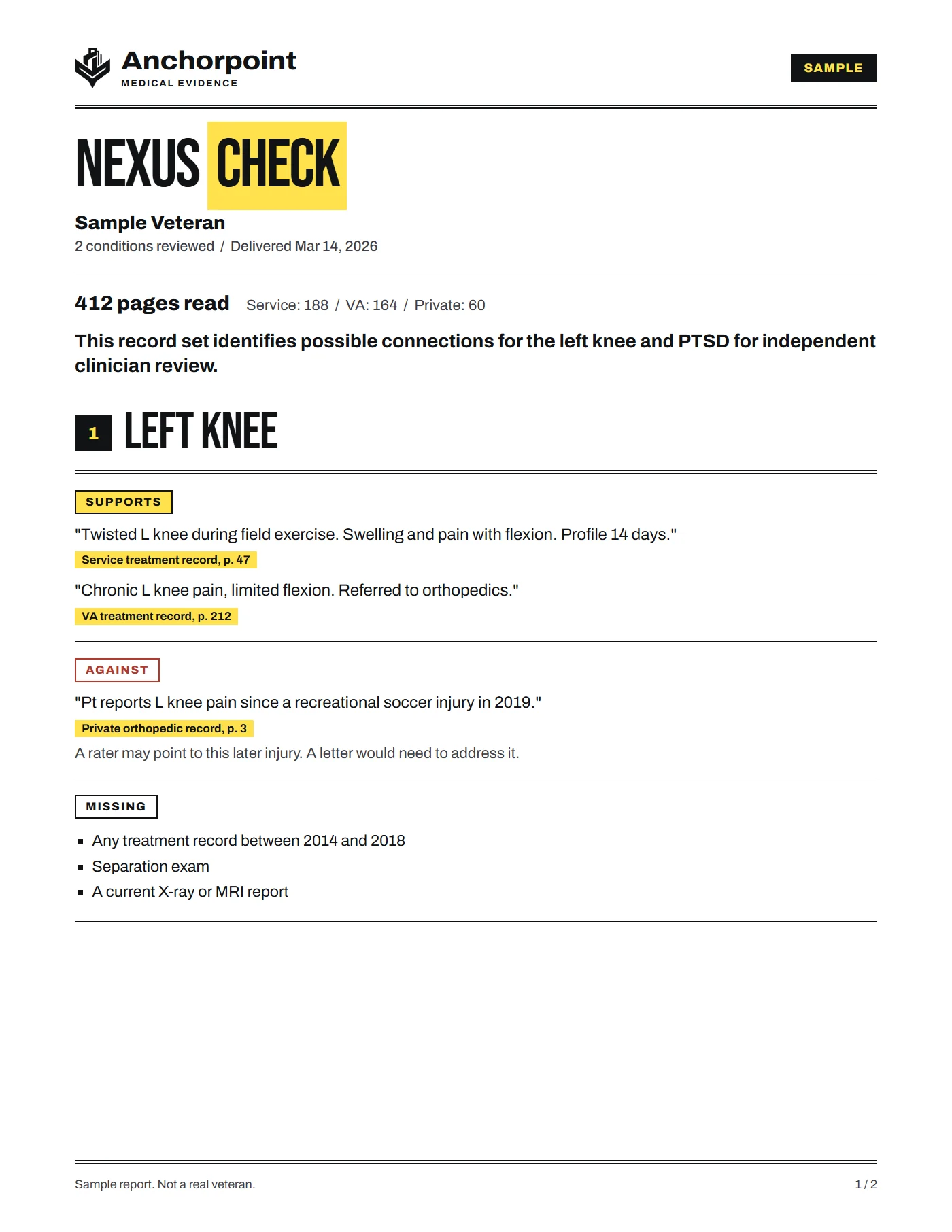
Our Nexus Check reads every page you send and cites the page for each finding, including pages that work against the claim. It’s free. If you request a letter, we draft it, and a licensed clinician reviews it, edits it and signs only what they support.
(360) 347-2563 · Mon–Fri 8am–5pm, Sat–Sun 8am–2pm Pacific. Outside those hours, request a call and we respond the next day we’re open.
If we don’t respond the same day during business hours, you get 15% off your nexus letter.
A call, voicemail or text from us counts as our reply. Business hours: Mon to Fri 8 to 5, Sat and Sun 8 to 2 Pacific. Terms
We don’t file claims or contact the VA for you. You or your accredited representative decide how to submit your evidence.
Public Board of Veterans’ Appeals decisions. These veterans weren’t Anchorpoint clients. Every claim is decided on its own evidence.