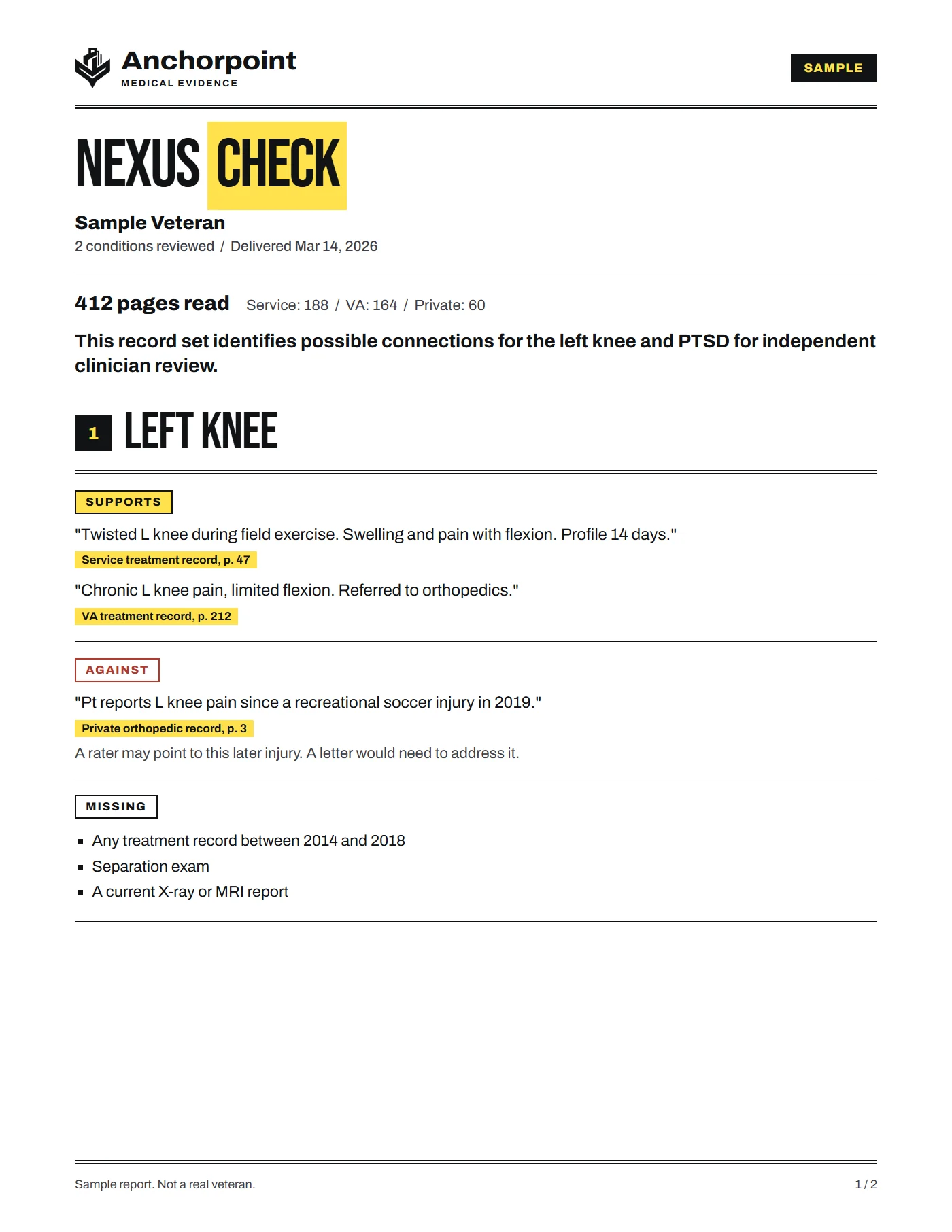
A nexus letter is a signed medical opinion that links a current condition to your service.
If the VA just denied your tinnitus claim: your decision letter lists the reasons. We read those reasons next to your records, page by page.
If you haven’t filed yet: the points below are what the Board weighed in these appeals. A letter can cover them from the start.
Why tinnitus claims get denied
We read 99 tinnitus denials from the 1,721 Board rulings in our 2022 to 2026 study. The main reason the Board gave:
- 65% The Board found the VA’s own exam or opinion more convincing (64 of 99)
- 16% No current tinnitus shown (16 of 99)
- 6% A long gap after service, with nothing to bridge it (6 of 99)
- 3% A legal rule ruled it out (3 of 99)
- 3% Nothing in the file linked tinnitus to service (3 of 99)
Most tinnitus denials follow one pattern: a VA audiologist said no, often pointing to normal hearing in service or a long gap, and no medical opinion stood on the other side. The Board also said the veteran’s own view of the cause wasn’t medical evidence (75 of the 99) and noted a long gap after service (73).
Counts come from what the Board wrote in each decision. None were Anchorpoint cases. How we counted
Where the VA exam and private letters fell short
These come from the decisions themselves.
- The VA exam points to normal hearing tests at discharge, or to no record of ringing in your service records.
- The VA exam treats tinnitus as part of hearing loss and never looks at it on its own.
- Your job in service is rated low-noise, and the exam stops there.
- Private letters fall short when they’re a fill-in-the-blank template, when they don’t say when the ringing started, or when they leave out loud work after service.
What the Board looked for
“Probative” is the Board’s word for convincing.
A private opinion against two VA opinions.Granted · 2025
“The Board finds that the private medical opinion is more probative than the two negative VA opinions.”
Two VA opinions said no. The private opinion cited studies showing a normal hearing test doesn’t rule out noise damage, reviewed the whole file, and considered the veteran’s own account.
Read decision A25051292 on VA.gov (opens in a new tab)Service records were missing.Granted · 2024
“Weighing the contradictory evidence, the November 2022 opinion was based on an examination of the Veteran and a review of the record, and was supported with a rationale that cited to and discussed relevant medical literature.”
The VA opinions leaned on the lack of complaints in service, but the service records were missing. The private audiologist examined the veteran, recorded when the ringing started, and cited studies.
Read decision A24040870 on VA.gov (opens in a new tab)The VA exam ignored the veteran’s own account.Granted · 2025
“In contrast, the private clinician reviewed the Veteran’s claims file, including the STRs, as well as her lay statement and medical literature.”
The VA examiner never discussed the veteran’s statement that the ringing began in service. The private clinician did, and checked it against the service treatment records (STRs).
Read decision A25051126 on VA.gov (opens in a new tab)A private letter the Board turned down.Denied · 2025
“As for the March 2023 private opinion, it is unclear if the examiner reviewed the claims file, nor did she address the Veteran’s post-service noise exposure.”
The records showed a loud job after service, and the ringing began on that job. The letter never dealt with it.
Read decision A25051764 on VA.gov (opens in a new tab)
What the opinions that won had in common
In 44 grants, the Board credited a veteran’s private medical opinion. Here is how often the Board said that opinion:
- 66% Used the VA’s standard, “at least as likely as not” (29 of 44)
- 66% Considered the veteran’s own account (29 of 44)
- 64% Explained its medical reasoning (28 of 44)
- 48% Named the clinician’s profession or specialty (21 of 44)
- 43% Came from a clinician who examined or interviewed the veteran (19 of 44)
- 39% Showed the clinician reviewed the records (17 of 44)
- 36% Cited medical studies (16 of 44)
- 20% Took on the VA examiner’s opinion (9 of 44)
Counts come from what the Board wrote in each decision. None were Anchorpoint cases. How we counted
What a strong nexus letter for tinnitus does
From the opinions the Board found convincing:
- Says when the ringing started and how it has gone since.
- Lists the real noise you faced in service, including training and duties outside your job title.
- Explains, with studies, why a normal hearing test doesn’t rule out noise damage.
- Addresses noise after service, like loud jobs or hobbies.
- Treats tinnitus as its own condition, separate from hearing loss.
- Shows it reviewed your claims file and service records.
- Gives real reasons. The Board called one template letter “vague and conclusory.”
See what your records support
Our Nexus Check reads every page you send and cites the page for each finding, including pages that work against the claim. It’s free. If you request a letter, we draft it, and a licensed clinician reviews it, edits it and signs only what they support.
(360) 347-2563 · Mon–Fri 8am–5pm, Sat–Sun 8am–2pm Pacific. Outside those hours, request a call and we respond the next day we’re open.
If we don’t respond the same day during business hours, you get 15% off your nexus letter.
A call, voicemail or text from us counts as our reply. Business hours: Mon to Fri 8 to 5, Sat and Sun 8 to 2 Pacific. Terms
We don’t file claims or contact the VA for you. You or your accredited representative decide how to submit your evidence.
Public Board of Veterans’ Appeals decisions. These veterans weren’t Anchorpoint clients. Every claim is decided on its own evidence.