A nexus letter is a signed medical opinion that links a current condition to your service. For mental health, it can also link depression or anxiety to a condition the VA already connects to your service, such as chronic pain.
If the VA just denied your mental health claim: your decision letter lists the reasons. We read those reasons next to your records, page by page.
If you haven’t filed yet: the points below are what the Board weighed in these appeals. A letter can cover them from the start.
Why PTSD and depression claims get denied
We read 164 PTSD, depression, and other mental health denials from the 1,721 Board rulings in our 2022 to 2026 study. The main reason the Board gave:
- 51% No current diagnosis, including none that met the standard mental health criteria (DSM-5) (84 of 164)
- 15% The Board found the VA’s own exam or opinion more convincing (25 of 164)
- 9% Nothing in the file linked the condition to service (14 of 164)
- 7% The event behind the PTSD wasn’t backed up in the record (11 of 164)
- 5% No event in service on record (9 of 164)
- 4% A legal rule ruled it out, mostly because a mental health condition was already service-connected (6 of 164)
Mental health is the one area where a missing diagnosis leads. The Board also often said the veteran’s own view of the cause wasn’t medical evidence (112 of the 164), and faulted private opinions for a wrong or incomplete history in 19. For PTSD, the record has to back up the event in service (19 denials noted it wasn’t). A medical opinion can’t do that by itself.
Counts come from what the Board wrote in each decision. None were Anchorpoint cases. How we counted
Where the VA exam and private letters fell short
These come from the decisions themselves.
- The VA exam points to no mental health treatment in service. In one 2025 appeal, the Board called a VA opinion resting on that alone “impermissible.”
- The VA exam gives a different diagnosis, such as alcohol use disorder, or says today’s symptoms don’t match what happened in service.
- The VA exam leans on assumptions, such as past substance use.
- Private letters fall short when they repeat your account with no reasoning, give a blanket statement, or only say a link is possible.
- For PTSD, the Board also needs support in the record that the event in service happened. A few denials turned on that, not on the letter.
What the Board looked for
“Probative” is the Board’s word for convincing.
No treatment in service didn’t settle it.Granted · 2025
“The Board affords no probative weight to the VA examiner’s nexus opinion because it is based solely on the fact that there was no evidence of in-service treatment for a psychiatric condition, which is impermissible.”
The VA examiner said no because there was no mental health treatment in service. The private psychologist linked the symptoms to what happened in service.
Read decision A25051820 on VA.gov (opens in a new tab)The VA exam called it something else.Granted · 2025
“The Board finds that the May 2024 private psychological evaluation is the most competent, probative evidence on the record regarding the etiology of the Veteran’s PTSD.”
The VA examiner called it alcohol use disorder. The private evaluation took a detailed history and tied the PTSD to combat.
Read decision A25051684 on VA.gov (opens in a new tab)Depression from service-connected pain.Granted · 2024
“The Board finds the July 2021 private opinion probative as it is well-developed and based on the Veteran’s history, and valid medical literature.”
Depression was tied to daily pain from service-connected back, knee, and ankle conditions. One service-connected condition can lead to another.
Read decision A24041712 on VA.gov (opens in a new tab)A private letter the Board turned down.Denied · 2024
“the psychologist failed to provide a thorough rationale to support his conclusion, providing merely a conclusory statement based primarily on the Veteran’s reports of in-service events”
The letter repeated the veteran’s account and stopped there.
Read decision A24041684 on VA.gov (opens in a new tab)
What the opinions that won had in common
In 100 grants, the Board credited a veteran’s private medical opinion. Here is how often the Board said that opinion:
- 82% Explained its medical reasoning (82 of 100)
- 70% Came from a clinician who examined or interviewed the veteran (70 of 100)
- 69% Named the clinician’s profession or specialty (69 of 100)
- 65% Used the VA’s standard, “at least as likely as not” (65 of 100)
- 65% Considered the veteran’s own account (65 of 100)
- 64% Showed the clinician reviewed the records (64 of 100)
- 24% Cited medical studies (24 of 100)
- 15% Took on the VA examiner’s opinion (15 of 100)
- 8 of 34 Addressed whether a service-connected condition made it worse (secondary claims only)
Counts come from what the Board wrote in each decision. None were Anchorpoint cases. How we counted
What a strong nexus letter for PTSD or depression does
From the opinions the Board found convincing:
- Rests on an interview, testing, and a full review of your records, and says so.
- Gives a diagnosis and explains which standard criteria you meet.
- Connects your symptoms to specific events in service, or to a service-connected condition such as chronic pain.
- Explains why there’s no treatment record from service, when there isn’t one.
- Addresses other explanations the VA raised, like alcohol use or life stress.
- Takes a clear position using the VA’s standard, “at least as likely as not,” which means a 50 percent or better chance. “Possible” isn’t enough.
See what your records support
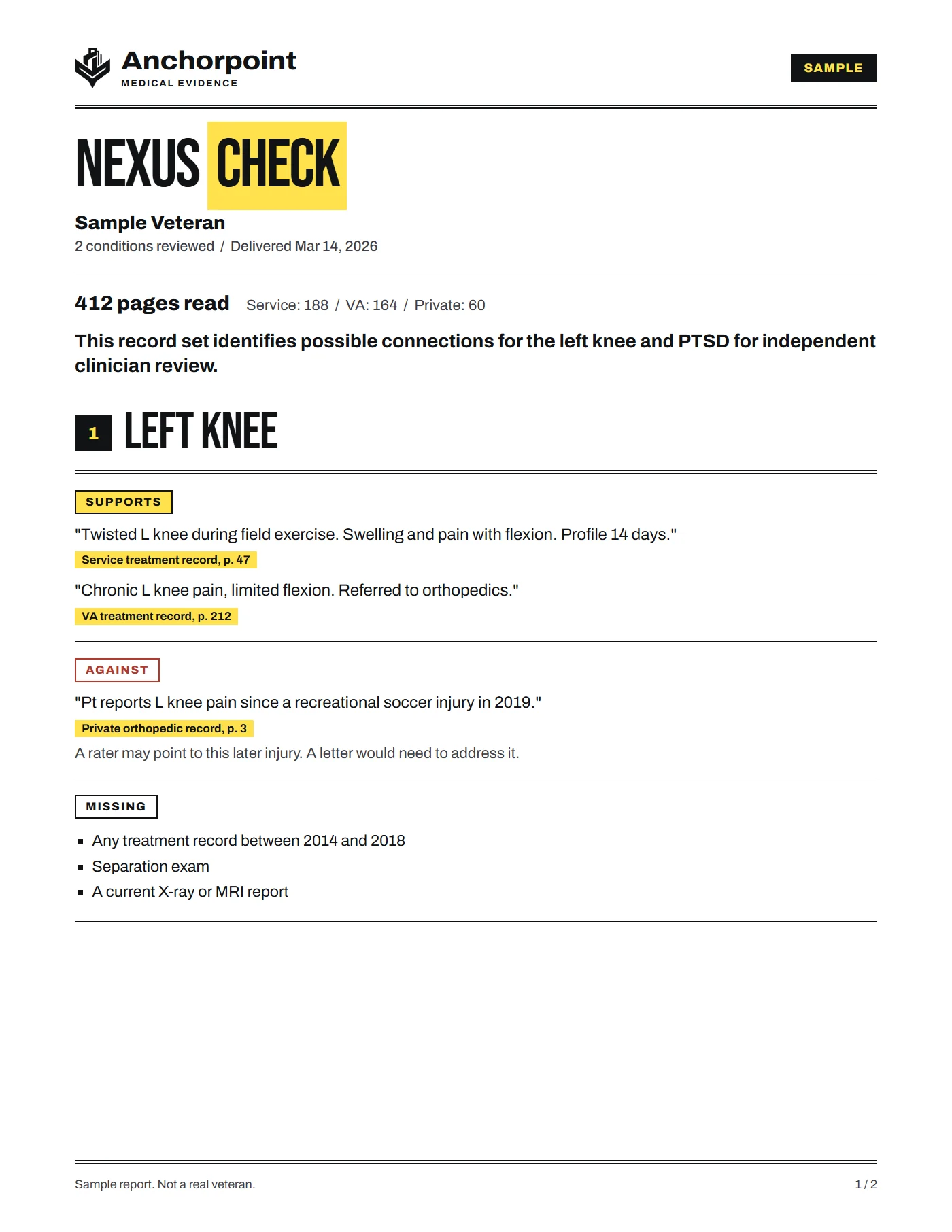
Our Nexus Check reads every page you send and cites the page for each finding, including pages that work against the claim. It’s free. If you request a letter, we draft it, and a licensed clinician reviews it, edits it and signs only what they support.
(360) 347-2563 · Mon–Fri 8am–5pm, Sat–Sun 8am–2pm Pacific. Outside those hours, request a call and we respond the next day we’re open.
If we don’t respond the same day during business hours, you get 15% off your nexus letter.
A call, voicemail or text from us counts as our reply. Business hours: Mon to Fri 8 to 5, Sat and Sun 8 to 2 Pacific. Terms
We don’t file claims or contact the VA for you. You or your accredited representative decide how to submit your evidence.
Public Board of Veterans’ Appeals decisions. These veterans weren’t Anchorpoint clients. Every claim is decided on its own evidence.